
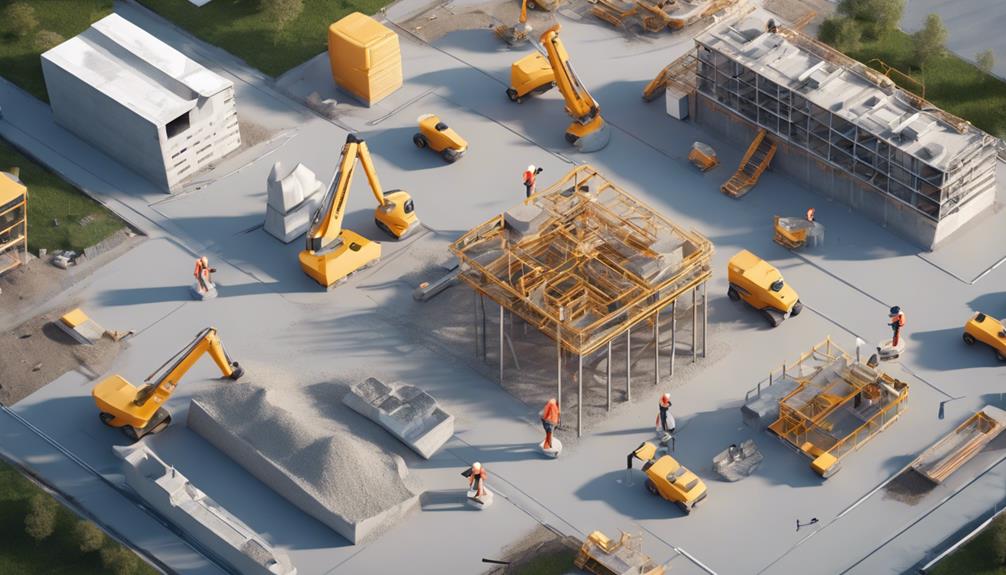
In 2023, you're seeing a revolution in construction technology with innovations designed to boost efficiency, safety, and sustainability. Autonomous construction technology lets machines work continuously without breaks, enhancing precision while reducing accidents and waste. You can explore designs in real-time using augmented reality and 3D tech, making it easier to make adjustments and enhance collaboration. Smart wearables are ramping up safety by monitoring workers' vital signs and environmental hazards, preventing incidents before they happen. Plus, advancements like 3D printing are reshaping building processes, enabling faster construction with less waste. These tools not only streamline operations but also open up new possibilities for creativity and efficiency in your projects.
Autonomous Construction Vehicles
Autonomous construction vehicles are transforming the building industry by executing tasks more efficiently and with fewer errors. You've probably seen the rise of driverless cars, but imagine that technology applied on a construction site. These vehicles range from excavators to bulldozers, all equipped with advanced sensors and GPS technology that allow them to operate with minimal human intervention.
You'll find that these machines can work around the clock. They don't need breaks or shifts, which significantly speeds up project timelines. Moreover, they're programmed to adhere strictly to predefined routes and patterns, reducing the risk of on-site accidents. This is crucial, considering the high rate of injuries in construction work.
These vehicles also contribute to precision. Since they're controlled by software, they can achieve exact movements that might be challenging for human operators. This precision reduces waste materials, which not only cuts costs but also minimizes environmental impact.
Adopting this technology might seem costly initially, but you'll see the return on investment through faster completion times and reduced labor costs. As you look forward to future projects, consider how integrating autonomous vehicles couldn't only streamline your operations but also enhance safety and efficiency on your sites.
Augmented Reality in Design
Augmented reality (AR) is revolutionizing the way you visualize project designs before the first stone is laid. With AR, you're no longer confined to 2D blueprints or small-scale models. Instead, you can see a full-scale, interactive 3D representation of your project overlaid onto the actual construction site. This allows you to explore various design options and make adjustments in real time, significantly reducing the likelihood of costly post-construction changes.
Imagine walking through your future building, observing how different materials and lighting options affect the ambiance, all before construction officially begins. AR also enhances collaboration among stakeholders. You can share the same visual perspective with architects, engineers, and clients, ensuring everyone's on the same page. This synchronization not only streamlines the decision-making process but also helps in identifying potential design conflicts early.
Moreover, AR can be a powerful tool for municipal approvals. By presenting a realistic visualization of how a new structure will look within its intended environment, you can address community concerns and regulatory requirements more effectively. This immersive technology isn't just changing the way designs are conceived but also how they're communicated and executed, making your projects more efficient and aligned with everyone's vision.
Smart Wearables for Safety
While augmented reality offers substantial improvements in design visualization, equally important advancements are being made in the realm of worker safety through smart wearables. You're now stepping into a construction site that's as connected as any high-tech office.
Imagine wearing a smart helmet that not only protects your head but also scans the environment for potential hazards. It's equipped with sensors that monitor your vital signs and alert you if you're experiencing stress or fatigue.
You've got a smartwatch on your wrist that sends real-time health and safety alerts. It vibrates if you're too close to a dangerous zone or if toxic gases reach critical levels. These wearables are synced with a central system, ensuring that supervisors can track every team member's location and well-being, enhancing collective safety protocols.
Moreover, your vest isn't just a high-visibility safety garment; it's embedded with electronics that regulate your body temperature and record your movements to analyze ergonomic risks. This gear isn't just protective; it's predictive, using data to foresee and prevent incidents.
This integration of smart wearables is transforming construction sites into safer, more efficient work environments. You're not just wearing gear; you're equipped with a personal safety consultant.
Advanced Modular Construction
Nearly every aspect of building processes is being streamlined thanks to advanced modular construction. You're seeing projects wrap up faster than ever, with components manufactured off-site in controlled environments. This isn't just about speed; it's about precision and efficiency too. The parts arrive ready to assemble, reducing on-site construction time and the typical disruptions caused by weather or scheduling conflicts.
You'll appreciate how this method cuts down on waste. Traditional building methods can be quite wasteful in terms of materials and energy. In contrast, modular construction uses materials more efficiently and often incorporates sustainable practices and materials. Moreover, the controlled factory setting minimizes the risk of material overuse and allows for tighter inventory control.
The scalability of modular construction is something you can't overlook. Whether it's expanding a school or building a new hotel wing, modules can be designed to fit the current need and easily adjusted or added in the future. This flexibility is key in rapidly changing urban landscapes.
As you look towards your next project, consider how advanced modular construction can't only meet your efficiency needs but also push you towards more sustainable and adaptable building practices.
AI in Project Management
In project management, AI is transforming how teams track and complete tasks. Imagine you're overseeing a large construction project. With AI, you're not just juggling schedules and manpower; you're leveraging smart algorithms that predict delays and optimize workflows. These systems can analyze data from ongoing projects in real-time, suggesting adjustments to keep everything on track and under budget.
You'll find AI tools particularly adept at risk management. They identify potential risks before they become issues, from supply chain disruptions to unexpected weather conditions. This isn't just about avoiding problems; it's about foreseeing them, giving you a strategic advantage in planning and resource allocation.
Moreover, communication across various project stages becomes seamless. AI integrates information from different teams, ensuring everyone's on the same page. This reduces misunderstandings and errors, streamlining operations and boosting productivity.
You're not chasing down emails or texts; you're getting concise reports and actionable insights directly.
As you move forward, adopting AI in your project management toolkit isn't just an upgrade; it's a necessity. It's about staying competitive and capable in a rapidly evolving industry. So, don't just manage projects—master them with the precision and efficiency that AI offers.
Green Building Materials
As the construction industry evolves, so does the importance of sustainable practices, particularly through the use of green building materials. You'll find that these materials not only help reduce your carbon footprint but also improve the overall efficiency and longevity of your projects.
Take bamboo, for instance. It's incredibly sustainable due to its rapid growth rate and is as durable as traditional hardwoods. You can use it for flooring, cabinetry, and more, significantly lowering the environmental impact of your constructions.
Similarly, recycled steel is a game-changer. It offers the same strength and durability as its virgin counterparts without the extensive energy consumption and waste production.
Then there's cork, a remarkable choice for insulation. It's not just natural and renewable; it's also great for thermal and acoustic insulation. This means you're not just building greener but also creating quieter, more energy-efficient spaces.
You should also consider low-VOC paints. These products minimize the release of harmful chemicals into the environment, making your construction sites healthier for workers and ultimately for the building's occupants.
3D Printing in Construction
Exploring the realm of 3D printing in construction, you'll discover how this technology revolutionizes building processes. 3D printing, or additive manufacturing, allows for the creation of complex structures with less waste and reduced labor costs. Imagine printing entire building sections layer by layer, using materials that range from concrete to polymers and composites. This method not only speeds up construction times but also enhances design flexibility, enabling you to realize shapes and forms that would be either impossible or too costly with traditional methods.
You'll find that 3D printing also contributes to sustainability. By precisely using materials only where needed, you'll significantly reduce the environmental footprint of your projects. The ability to recycle materials directly on-site is another perk, minimizing the need for transportation and further cutting down on emissions.
Furthermore, the integration of 3D printing in construction leads to safer work environments. With machines handling the most hazardous tasks, you'll see a drop in workplace accidents, making construction sites safer for everyone involved.
This technology isn't just about creating structures; it's about reimagining what's possible in the built environment. As you adopt 3D printing, you're stepping into a future where construction is faster, safer, and greener.
Real-Time Collaboration Tools
Switching focus to Real-Time Collaboration Tools, you'll notice how vital these systems are in modern construction projects. They're not just a convenience; they're a game changer.
Imagine coordinating multiple project sites with live updates. You no longer rely on delayed reports or emails that sit unread. Instead, you get instant communication, ensuring that every team member, from architects to engineers, is on the same page.
With these tools, you're equipped to make decisions quickly. If there's an issue, you don't wait for the next site visit to resolve it. You can address it immediately through a shared digital platform where all project data is accessible and updatable in real-time.
This means fewer mistakes, less rework, and a significantly streamlined workflow.
Moreover, these tools integrate seamlessly with other software, enhancing overall efficiency. They support various formats and devices, allowing on-the-go access to project details, which is essential in today's fast-paced construction environments.
The result? Projects are completed faster, with higher quality and lower costs.
Embracing these tools not only boosts your project's efficiency but also positions your business as a modern and adaptive competitor in the construction industry.
Energy-Efficient Building Systems
The construction industry's embrace of energy-efficient building systems marks a pivotal shift towards sustainability. You're seeing a revolution unfold as builders and architects adopt technologies that not only reduce energy consumption but also cut down long-term operational costs. It's about smarter resource use, harnessing renewable energy, and optimizing building designs for maximum efficiency.
Imagine living or working in a space where the heating, ventilation, and air conditioning (HVAC) systems are so advanced that they adjust themselves based on real-time occupancy and weather data. That's not just a pipe dream anymore. These systems are being integrated today, reducing energy waste dramatically. You're looking at buildings that can maintain perfect indoor climates with minimal energy use, thanks to smart thermostats and AI-driven controls.
Moreover, the materials used in construction now often include recycled content and are sourced sustainably to minimize environmental impact.
You'll find that new buildings are equipped with better insulation materials, high-efficiency windows, and LED lighting systems—each playing a crucial role in decreasing the carbon footprint.
As you step into this new era, it's clear that adopting these innovations isn't just good for the planet—it's also economically sensible. You're not just constructing buildings; you're building a sustainable future.
Conclusion
You've just explored the cutting-edge of construction technology for 2023. From autonomous vehicles reshaping how projects are executed, to AR and AI enhancing precision and efficiency, your toolkit is expanding. Embrace smart wearables to boost safety and modular techniques for speed. Lean on green materials and 3D printing for sustainability. With these innovations, you're not just building structures; you're crafting the future. Dive in, harness these tools, and transform your construction projects into models of modern efficiency and sustainability.
Related articles: Top 3 New Commercial Construction Technologies · Quiz: Discover the Newest Construction Tech Innovations · Revolutionary Breakthroughs Disrupting Commercial Construction