
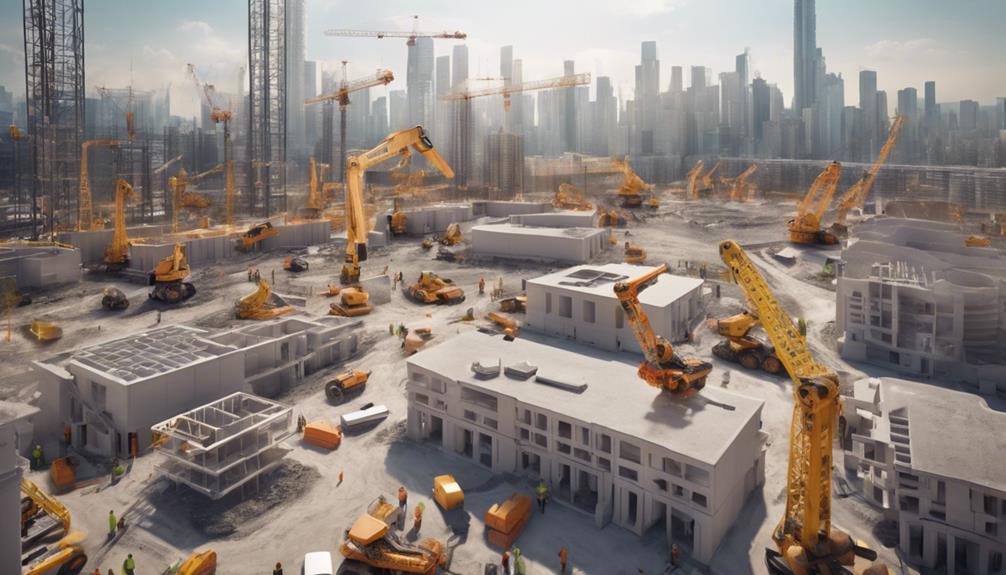
You're experiencing the future of commercial construction, molded by revolutionary breakthroughs that are dramatically transforming the way buildings come to life. Smart building materials adapt to environmental changes, slashing maintenance costs and boosting durability. Modular construction and advanced prefabrication methods streamline the building process, ensuring faster, waste-reduced assembly that doesn't compromise on quality. From 3D printing creating complex, sustainable structures, to autonomous machinery and robotics enhancing precision and efficiency, you're at the forefront of an industry evolving at an unprecedented pace. This surge in innovation not only refines how projects are executed but also opens up incredible possibilities in design and sustainability. Uncover what lies ahead and how it could redefine your projects.
Smart Building Materials
One often hears about innovations that promise to transform industries, but smart building materials genuinely revolutionize commercial construction. These aren't your standard bricks and mortar. Imagine materials that adapt to environmental changes, conserve energy, and even self-heal. You're not just building; you're investing in the future of infrastructure.
Take phase-changing materials (PCMs), for instance. Integrated into walls or ceilings, they absorb or release heat depending on the temperature, maintaining a building's internal environment. You'll appreciate this on a sweltering summer day or a freezing winter night without the high energy bill that typically accompanies comfort.
Then there's self-healing concrete. Infused with bacteria that produce limestone, it fills cracks formed over time. It's like having a maintenance crew built right into the structure, continually working to extend its lifespan.
These innovations don't just add to the cost; they're cost-saving in the long run. They reduce maintenance expenses, energy consumption, and even insurance premiums due to their enhanced durability.
As you plan your next project, consider how smart materials can't only save money but also create a building that stands out for its innovation and sustainability.
Modular Construction Techniques
Shifting focus to modular construction techniques, you'll find this method streamlines the building process significantly. You're not just saving time; you're also reducing waste. Imagine constructing whole building sections in a factory setting—this is the heart of modular construction. Here, large modules are built, including walls, ceilings, and floors, which are then transported to the construction site.
Once on site, these modules are assembled much like building blocks. It's straightforward and fast. You're likely to see a building come together in a fraction of the time it takes for traditional construction methods. This isn't just efficient; it's also incredibly precise. Factory settings allow for tighter controls and adherence to specifications, which means fewer discrepancies and errors.
Moreover, you're not dealing with the usual delays typical of on-site construction. Weather delays? Less problematic. Material shortages? Not as likely. Everything needed is pre-arranged and crafted off-site, reducing the chance of unexpected hold-ups.
This method isn't just about efficiency, though. It also promotes sustainability. With less waste and a reduced need for on-site resources, you're contributing to a greener building process. Embracing modular construction doesn't just meet current demands—it's a step towards the future of building.
Advanced Prefabrication Methods
As the construction industry evolves, advanced prefabrication methods are paving the way for even more efficient building processes. You've likely noticed how swiftly new buildings are springing up, and much of this speed is thanks to these innovative techniques. Prefabrication isn't just about speed; it's also significantly reducing waste and improving safety on construction sites.
Imagine components like walls, floors, and roof trusses being assembled in a controlled factory setting before being transported to the site. This shift means you're seeing fewer delays due to weather, and there's less noise and disruption at the construction site itself.
It's not just about assembling parts faster; it's about smarter, sustainable building.
You're also seeing a surge in customization options. Unlike traditional methods that might limit design due to onsite constraints, prefabrication offers the flexibility to explore more complex designs and integrate various materials. These components are engineered with precision, ensuring that when they arrive on site, they fit together perfectly, reducing the need for adjustments and modifications.
This method isn't just transforming how quickly buildings can go up; it's revolutionizing the quality and efficiency of construction projects, turning what used to be months of work into weeks. You're witnessing a significant shift in how structures come to life, reshaping skylines faster than ever before.
3D Printing in Construction
Building on the momentum of advanced prefabrication methods, 3D printing technology is setting new standards in the construction industry. You've likely heard about 3D printing for small gadgets or even medical applications, but it's now revolutionizing how large structures are built.
This isn't just about innovation for the sake of it; you're looking at a future where construction times plunge and design possibilities expand beyond traditional methods.
Imagine you're constructing a complex, curved facade that would typically require intricate molds and a lot of manual labor. With 3D printing, you can produce these unique shapes directly from a digital model, drastically reducing both the time and cost.
Moreover, the materials used in 3D construction printing, such as concrete and composites, are evolving to offer greater durability and sustainability. This means you're not only speeding up the building process but also contributing to a greener construction environment.
Beyond just the practicalities, think of the creative freedom this technology grants architects and designers. Complex geometries that once seemed far-fetched or too costly to consider are now within reach. You're witnessing a shift where the only limit to what can be built is the imagination itself.
Autonomous Construction Machinery
The integration of autonomous construction machinery is transforming the way projects are executed. Imagine you're overseeing a construction site where robots and autonomous vehicles do the heavy lifting. You're no longer tied down by the limitations of human endurance, and the risks associated with dangerous tasks are significantly reduced. This isn't just a glimpse into the future; it's the reality you can tap into today.
Autonomous machinery includes drones that survey sites and robots that lay bricks or tie rebar, all without a human hand guiding them. You'll find these machines can work around the clock, boosting productivity exponentially. Moreover, they're programmed to follow precise specifications, reducing errors and material waste. This accuracy not only saves money but also speeds up the overall construction timeline.
Imagine a world where you can deploy a fleet of machines at the touch of a button. Scheduling becomes a breeze as these autonomous units are synced to a central system, ensuring seamless operation. You're able to monitor progress remotely, making adjustments in real-time and predicting project timelines more accurately.
This level of automation in construction isn't just convenient; it revolutionizes how you plan, execute, and complete projects. Embrace this change, and you'll lead the way in building smarter, faster, and safer.
Green Building Innovations
Several green building innovations are reshaping the construction landscape, making it more sustainable and efficient. You're seeing the rise of materials that not only reduce the ecological footprint but also provide better performance. For instance, bio-based materials like hempcrete and recycled plastic are becoming more prevalent. They offer significant insulation properties and durability, drastically cutting down on energy costs.
You'll also find that green roofs are no longer a novelty but a necessity in urban design. These living roofs don't just beautify buildings; they contribute to thermal regulation and improve air quality, making your projects stand out for their eco-credentials.
Additionally, the integration of solar technology has shifted from optional to essential. Photovoltaic glass isn't just for rooftops anymore; it's being incorporated into the very facade of buildings, transforming every surface into an energy-harvesting powerhouse.
Moreover, the push for net-zero buildings is creating a competitive edge in the market. As you adopt these standards, you're not just following trends; you're setting them. Building projects that prioritize sustainability are attracting more investors and tenants who are eager to align with green values. This shift isn't just good for the planet, it's smart business.
Augmented Reality Applications
Augmented reality (AR) is revolutionizing your approach to commercial construction projects. By overlaying digital information onto the real world, you're able to visualize architectural designs and structural elements in real-time at the construction site. This isn't just about seeing a 3D model on a screen; it's about integrating that model with the physical space to enhance both understanding and communication.
Imagine you're walking through an unfinished building, but through your AR headset, you see the completed version. Walls, electrical systems, and plumbing that haven't been built yet appear before your eyes. This helps you spot potential issues before they become costly mistakes. It's like having a glimpse into the future, allowing you to make adjustments that save time and money.
Furthermore, AR facilitates real-time collaboration among various stakeholders. You can share what you're seeing with a remote team member, who can provide instant feedback or make design changes on the fly. This level of interaction ensures everyone's on the same page, reducing misunderstandings and delays.
As you adopt AR tools, you're not just keeping up with technology—you're staying ahead. In a competitive field like construction, AR isn't just useful; it's becoming essential to maintaining your edge.
Internet of Things Integration
While augmented reality enhances visualization in commercial construction, integrating the Internet of Things (IoT) propels your project management capabilities to new heights. Imagine sensors embedded throughout your construction site, constantly feeding data back to your central system. You're not just overseeing a project; you're receiving real-time insights on everything from material durability to environmental conditions.
This isn't the future—it's your new reality with IoT.
You can track the location and operation of equipment, monitor structural health, and even predict maintenance needs before they become costly. IoT devices make your job site smarter; they communicate issues immediately, allowing you to address them swiftly and efficiently. It's all about minimizing downtime and enhancing productivity.
Moreover, IoT integration means you're better equipped to ensure worker safety. Sensors can alert you to hazardous conditions, reducing the risk of accidents and reinforcing a culture of safety. Plus, with IoT, your resource management becomes more precise. You'll know exactly when to reorder materials and optimize your inventory, avoiding both surpluses and shortages.
Robotics and Automation Advances
As the commercial construction industry embraces robotics and automation, your project's efficiency and precision are set to soar. You'll witness a remarkable transformation in how structures are built as machines and automated systems undertake tasks that were once manually intensive.
Drones now conduct site surveys with pinpoint accuracy, allowing for precise measurements and faster project initiation.
You're also seeing robots lay bricks and install drywall, tasks that not only move swiftly but with a consistency that minimizes errors and material waste. These advances aren't just speeding up construction; they're enhancing worker safety. Robots can operate in hazardous conditions where human safety would be at risk, reducing workplace accidents and increasing overall site security.
Moreover, automated machinery is revolutionizing supply chain logistics within construction. Automated guided vehicles efficiently transport materials across sites, streamlining operations and cutting down on delays.
This integration of robotics ensures that you're not just meeting deadlines but are also capable of handling more complex projects with greater cost effectiveness.
Embrace these technologies to stay competitive. As automation becomes more advanced, being at the forefront will ensure your projects aren't only successful but also landmarks of innovation in construction.
Conclusion
You're witnessing an era where innovation reshapes commercial construction profoundly. Smart materials and modular techniques cut costs and time, while advanced prefabrication and 3D printing push boundaries. Autonomous machinery and green innovations are making sites safer and more sustainable. With augmented reality and IoT, you're more connected than ever, overseeing projects with precision. And with robotics and automation, you're not just building; you're revolutionizing every step. Embrace these changes—they're not just trends, they're the future.
Related articles: Top 3 Construction Management Tech Tools · Top 3 Construction Management Tech Innovations · Why Are New Construction Management Tools Game-Changers?