
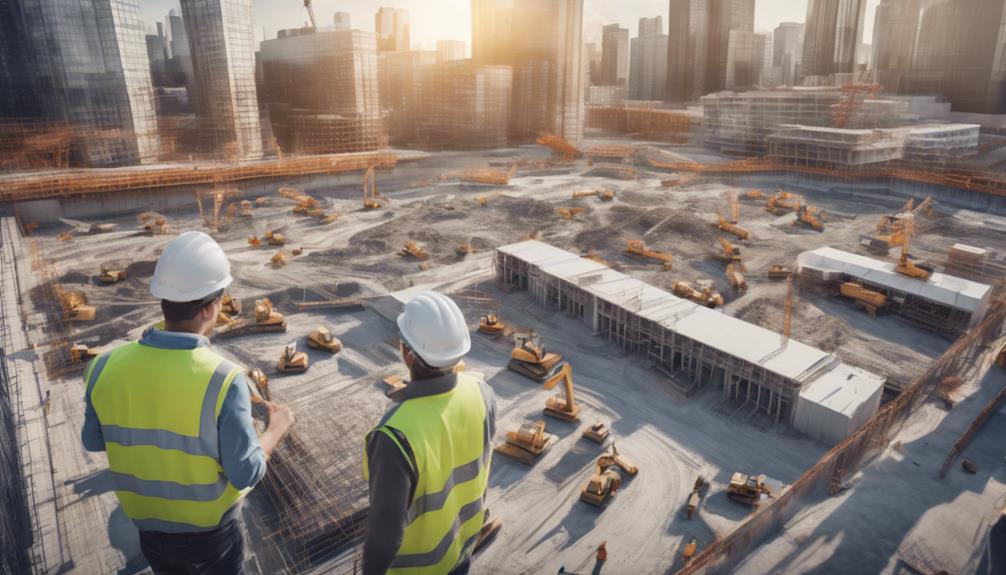
You're in the midst of a revolution in commercial construction management, where technologies like advanced BIM software, IoT monitoring, and AI-driven optimization are changing the game. Picture managing your project with 3D visualizations that integrate all data points and simulate scenarios to optimize resources. Imagine onsite IoT sensors tracking every aspect of your site's efficiency, while AI predicts timelines and automates decisions. Add to this drones and AR enhancing surveying and blueprint accuracy, and robots boosting onsite safety and efficiency. Each innovation not only streamlines processes but also paves the way for future advancements. Exploring these tools further might open up new possibilities for efficiency and precision in your projects.
Advanced BIM Software Capabilities
Advanced BIM (Building Information Modeling) software capabilities have transformed how you manage commercial construction projects. With state-of-the-art BIM tools, you're now able to visualize projects in stunning 3D, allowing for a deeper understanding of the construction process before breaking ground. This isn't just about seeing a building's structure; it's about experiencing the space, anticipating potential issues, and planning accordingly.
You can now integrate various data points into one cohesive model. For instance, by incorporating cost analysis and timelines directly into your BIM software, you're not only tracking the architectural design but also aligning it with budgeting and scheduling in real-time. This integration ensures that you stay on top of finances and timelines, reducing the risk of overruns.
Moreover, BIM software facilitates enhanced collaboration among stakeholders. Whether you're in the office or out in the field, you and your team can access and update models in real-time. This immediate exchange of information leads to more informed decision-making and a more synchronized project team.
Lastly, BIM's capability to simulate different construction scenarios helps you optimize processes and resource allocation. By foreseeing and mitigating challenges before they manifest on site, you enhance efficiency and productivity, ensuring smoother project execution.
IoT in On-Site Monitoring
Building on the capabilities of modern technology, the integration of the Internet of Things (IoT) in on-site monitoring has revolutionized your approach to managing commercial construction projects. With IoT, you can now seamlessly track real-time data from various sensors placed across the construction site. These sensors monitor a range of critical parameters including temperature, humidity, structural integrity, and even the presence of hazardous gases.
This constant flow of information enhances your ability to make data-driven decisions quickly. You don't have to wait for manual reports or routine checks. Instead, you get instant alerts if something's amiss, which means you can address potential issues before they escalate into costly delays or safety hazards.
Moreover, IoT devices help you oversee machinery and equipment usage, ensuring optimal performance and preventive maintenance.
What's more, the data collected from IoT sensors provides you with detailed insights into the efficiency of your site operations. You can analyze this data to identify patterns, predict project outcomes, and refine your strategies, leading to more efficient use of resources and improved project timelines. IoT doesn't just support your current project; it sets the stage for continuous improvement in all your future endeavors.
AI-Powered Project Planning
Harnessing AI-powered tools in project planning transforms how you tackle scheduling and resource allocation challenges in commercial construction. As you dive into this innovative approach, you'll notice a significant shift in how projects are mapped out. AI algorithms can predict project timelines more accurately by analyzing vast amounts of data from past projects. This capability enables you to foresee potential delays and adjust resources accordingly, ensuring that deadlines are met without compromise.
With AI, you're not just planning; you're predicting. It lets you simulate various scenarios to see the impacts of different decisions before making them. This means you can optimize your strategy based on solid data, rather than just intuition.
For instance, AI can help you decide the best time to order materials to avoid delays or price hikes, which is crucial in managing budget constraints effectively.
Moreover, these tools integrate seamlessly with other digital solutions you're already using, creating a cohesive system that enhances communication across all levels. You'll find that team coordination improves as everyone has access to real-time updates, making it easier to stay on track and adapt to any changes swiftly.
Robotic Automation Trends
As you explore the potential of AI in project planning, it's equally important to consider how robotic automation is reshaping the construction landscape. Robots are now taking over tasks that were traditionally manual, risky, or time-consuming, significantly boosting efficiency and safety on-site.
Imagine robotic arms that lay bricks or concrete precision-milled by automated machines. These aren't distant future scenarios; they're current trends that are transforming how buildings are constructed. Robots don't just work faster; they also work longer hours without fatigue, reducing project timelines dramatically.
You've likely heard about robots used for repetitive tasks, but today's models can adapt to complex environments. They're equipped with sensors and AI that allow them to navigate through construction sites, recognize patterns, and even respond to changes in their surroundings. This adaptability makes them invaluable for tasks like structural assembly or hazardous material handling, where precision and safety are paramount.
Moreover, robotic automation isn't just about the heavy lifting. It encompasses a range of support functions, from automated logistics on-site to real-time data collection, ensuring that every phase of construction is optimized for efficiency and cost-effectiveness. As you integrate these tools, you'll find they're not just changing the workflow; they're revolutionizing the entire building process.
Drone Technology for Surveying
Transitioning from ground to air, drone technology is revolutionizing the way surveying is conducted in commercial construction. You're now witnessing a significant shift where traditional methods, often slow and labor-intensive, are being replaced by agile, precise aerial solutions.
Drones provide you with a comprehensive view of your project site, capturing high-resolution images and data from vantage points that were once impossible or cost-prohibitive to reach.
By integrating drone technology, you're not just speeding up the surveying process; you're enhancing accuracy. Drones can quickly map large areas, reducing human error and the need for costly rework. They're equipped with advanced sensors and cameras that deliver real-time insights, allowing you to make informed decisions faster.
This technology also improves safety on your construction sites. You can now conduct surveys in potentially hazardous areas without risking worker safety. Drones monitor site conditions and progress, ensuring compliance with safety standards and helping you identify risks before they become problems.
Embracing drone technology in surveying means you're at the forefront of efficiency, safety, and precision. It's not just about keeping up; it's about staying ahead, transforming challenges into opportunities for innovation and growth in your construction projects.
Real-Time Collaboration Platforms
In the realm of commercial construction, real-time collaboration platforms are transforming how teams communicate and work together. You've likely experienced the frustration of delayed communications and mismanaged data, which can derail project timelines. Now, imagine a scenario where updates, documents, and feedback are exchanged in a flash among architects, engineers, and contractors, no matter where they are. This isn't just convenient; it's revolutionizing the industry.
You see, these platforms integrate various forms of communication into a single interface. You can share files, discuss project details, and manage tasks without switching between different apps. It streamlines processes and ensures everyone stays on the same page.
Moreover, the ability to track changes and access documents in real-time reduces errors and saves valuable time.
Think about the impact on your projects. Reduced misunderstandings, fewer delays, and a cohesive team working toward a common goal. With real-time collaboration tools, you're not just building structures; you're building efficiency.
As the industry evolves, staying updated with these technologies isn't just advisable; it's essential to maintain competitiveness and project success. Embrace these tools, and watch your projects transform.
Augmented Reality for Blueprints
Stepping into the world of augmented reality (AR) for blueprints offers profound advantages for commercial construction projects. Imagine you're walking through a physical construction site, but instead of carrying stacks of paper blueprints, you're equipped with AR glasses. You can see the digital overlays of the blueprints right on the actual building structures. This integration isn't just cool; it's revolutionizing how you visualize, interpret, and execute building designs.
With AR, you can spot discrepancies between planned designs and the current build instantaneously. This immediate feedback allows you to make corrections on the fly, reducing costly delays and reworks. You're not just looking at a flat diagram; you're experiencing the spatial relationships and dimensions in real-time, which enhances your understanding and decision-making capabilities.
Moreover, AR for blueprints facilitates better communication among your team. When everyone, from architects to engineers to builders, sees the same augmented reality, misunderstandings diminish significantly. You're all literally seeing the building from the same perspective.
This technology isn't just a step forward; it's a leap into efficiency and precision. As you adopt AR, you're not just following trends—you're setting them, ensuring your projects aren't only successful but also cutting-edge.
Sustainable Construction Innovations
Amidst the push for eco-friendliness, sustainable construction innovations are reshaping the industry. As you look to the future, you'll find that integrating green technology and methods into your projects isn't just an ethical decision—it's also economically wise.
You've likely heard about green roofs and solar panels, but the realm of sustainable construction goes beyond these visible markers. Advances in materials are pivotal. For instance, consider self-healing concrete, which incorporates bacteria that produce limestone to fill cracks that develop over time. This not only extends the material's lifespan but also reduces maintenance costs and resource usage.
Energy efficiency is another key area. Smart glass, which adjusts its transparency to control solar radiation entering a building, can drastically cut heating and cooling demands. You'll save on energy bills and enhance occupant comfort.
Moreover, the adoption of recycled and locally sourced materials is gaining traction. These practices reduce the carbon footprint associated with transport and production, and they often offer cost savings in the long term.
As you integrate these innovations, you'll not only adhere to stricter environmental regulations but also meet a growing consumer demand for sustainable living spaces. Remember, every green choice you make contributes to a larger global impact.
Modular Construction Breakthroughs
Modular construction is revolutionizing how we build, allowing projects to be completed faster and with less waste than traditional methods. Imagine having major components of a new building manufactured in a controlled factory setting. It's not just about efficiency; it's about precision, reducing the room for error seen on traditional sites.
You might wonder about the range of applications. Well, from hospitals to schools, modular units are being tailored to meet diverse needs. The entire rooms, complete with electrical and plumbing fixtures, are assembled off-site and transported to the location for final assembly. This shift not only speeds up construction timelines but also significantly cuts down on-site disruptions.
Moreover, this method enhances worker safety. By constructing in a controlled environment, risks associated with weather and on-site injuries are drastically minimized.
You're looking at a future where construction sites are less cluttered and more organized, making them safer and more efficient.
Machine Learning in Budgeting
Many construction firms are now leveraging machine learning to streamline their budgeting processes. You've likely encountered traditional methods, which often rely on manual data entry and gut feelings. But imagine a system where predictive analytics help you foresee cost overruns and save money before they even happen.
This isn't just a futuristic dream. Today, machine learning algorithms analyze historical data and ongoing project metrics to provide you with real-time budget forecasts. They spot patterns that you might miss and suggest where to cut costs without compromising quality.
For example, if material costs are fluctuating, the system can recommend the best time to buy or suggest alternative suppliers.
You'll also find these tools incredibly useful for labor allocation. By predicting the phases of your project that will require more manpower, you can optimize your workforce and avoid the extra cost of last-minute hires. These predictions are based on a multitude of factors, including past project timelines compared against the current progress.
Conclusion
You're on the brink of a construction revolution. With advanced BIM software, IoT monitoring, and AI in project planning, managing commercial construction is becoming more efficient. Robotic automation and drones are reshaping how tasks are performed, while augmented reality brings blueprints to life. Embrace sustainable and modular innovations to stay ahead. Machine learning is even simplifying budgeting. It's an exciting time to leverage these tools and transform how you build. Get ready to innovate and lead.
Related articles: What Are the Top Smart Building Technologies?